Your rates page does more than list numbers. It tells prospective clients which arrangements are available, how the options compare and what kind of inquiry makes sense.
For an independent escort, the aim should be a rate structure you are willing to honour and a presentation people can understand. You can make preferred arrangements easier to notice without assuming a particular table will make clients choose them.
Start with the way you want to work. Then check what your rate structure communicates.
Decide which bookings you actually want to offer
A preferred duration should reflect your availability, energy, preparation, travel and the experiences you enjoy offering. Longer bookings may reduce the number of separate arrangements you need to organize. They can also occupy more of your day, limit other opportunities and require more planning or recovery time.
Shorter appointments can be entirely appropriate for a provider who prefers them. A longer booking is not automatically more profitable, more enjoyable or a better fit.
List the options you would be comfortable accepting at their stated rates. If you do not want to offer a duration, reconsider including it. An option should have a real purpose rather than exist only to make another one look attractive.
Compare total prices and the cost of additional time
Here is a hypothetical example, using USD solely to make the arithmetic clear. These figures are not recommended rates or evidence of what any local market supports.
| Duration | Structure A | Structure B |
|---|---|---|
| 1 hour | $700 | $700 |
| 1.5 hours | $900 | $1,000 |
| 2 hours | $1,200 | $1,200 |
| 3 hours | $1,600 | $1,600 |
In Structure A, moving from 1.5 to 2 hours costs another $300. In Structure B, it costs another $200. The two-hour rate has not fallen. The 1.5-hour rate has risen.
That smaller difference may make the two-hour option look relatively appealing to someone who already wants more time and can afford it. Someone with a $1,000 limit may still choose 1.5 hours. Someone with only an hour available may ignore the comparison altogether. Others may decide not to inquire.
In Structure B, the average rate is $700 per hour for one hour, about $667 per hour for 1.5 hours, $600 per hour for two hours and about $533 per hour for three hours. The total payment rises while the average payment per booked hour falls.
Those are different measures. Neither tells you the profit or the best option for your business without accounting for costs and the time outside the booking.
Why this is not a straightforward decoy effect
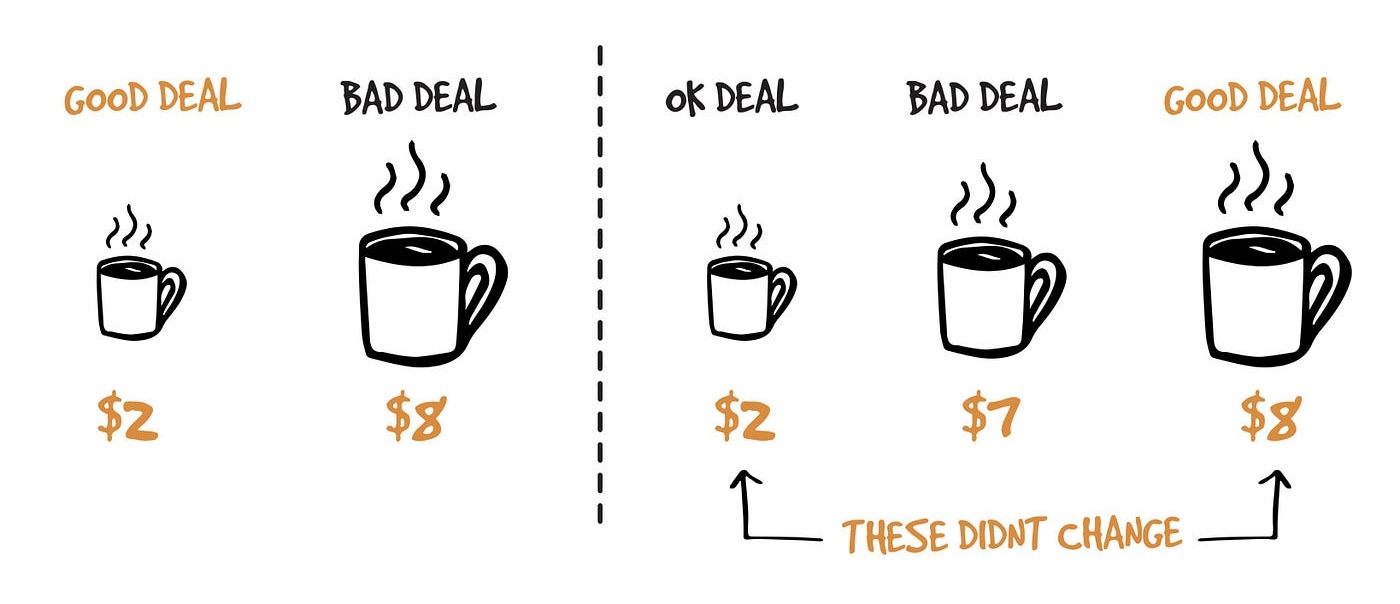
The classic decoy effect studied by Huber, Payne and Puto concerns adding an alternative that is no better than one existing option on the compared attributes and worse on at least one, while not being dominated by another. The term is more specific than “the larger option looks like better value.”
The 1.5-hour option above remains cheaper in total than the two-hour option. There is a trade-off between time and cost, and more time is not necessarily better for the person choosing. The table also changes an existing price rather than demonstrating the effect of adding a new option.
It is more accurate to discuss pricing increments and perceived relative value. The arithmetic establishes how prices compare; it does not establish how many clients will change their choice. You do not need a behavioural label to make a useful rates page.
Keep the options easy to distinguish
Use a consistent order, such as shortest to longest duration, with the total price beside each option. State the currency. If arrangements differ in more than duration, explain the relevant difference rather than asking the reader to infer it from a name.
There is no universal ideal number of options. Include enough to represent the arrangements you genuinely offer, and remove near-duplicates that create questions without serving a useful purpose. Some businesses need only a small table; others need separate sections for materially different arrangements.
A descriptive name can add personality, but keep the duration visible. “Dinner date” by itself does not establish how much time is included. Likewise, “from” pricing needs an explanation of what changes the final amount.
Do not make visitors calculate the minimum total from an attractive hourly figure if your minimum is several hours. The amount needed to arrange the stated option should be understandable at a glance.
Explain the practical conditions near the relevant option
A reader should be able to understand the minimum duration, notice needed and whether the listed amount applies to their location or type of request. If meals, transport or other expenses are separate, make that clear before an inquiry progresses.
For arrangements requiring an individual quote, explain which details you need and how the quotation process works. Avoid presenting a fixed-looking price that becomes something different only after someone contacts you.
Keep deposit, cancellation and confirmation information consistent with your actual process. A deposit credited toward the stated total should not be confused with an additional fee. Detailed terms can sit elsewhere, with a clear link from the rates page.
Check the FAQ, availability page and inquiry form whenever rates change. One accurate table will not resolve an old minimum repeated elsewhere. My guide to planning the pages on an escort website explains how those sections can work together.
Make a preference visible without misleading the reader
If you especially enjoy a particular arrangement, you can say why in plain language. Perhaps it allows time for dinner and conversation. Describe what you genuinely offer, keeping practical details as visible as the appealing description.
A subtle visual emphasis can help readers notice that option. It should not hide other prices, preselect an arrangement without a clear choice or make the least expensive available option difficult to find.
Use “most popular” only when you have a current, supportable basis for the claim. “My preferred arrangement” describes your own preference more accurately when that is what you mean. Do not manufacture limited availability to create pressure.
Also make the next step accurate. If you review requests before agreeing to them, a button should invite an inquiry rather than imply an immediate confirmed booking.
Review the business effect, not just the average booking length
Suppose Structure B produces more two-hour requests. That could be useful, but it is not enough to judge the change. You might receive fewer suitable inquiries overall, spend more on arrangements or fill time you would prefer to keep free.
Look at confirmed booking mix, total revenue, expenses, preparation and communication time, cancellations and whether the work suits you. A higher average booking value can coexist with lower total revenue or a less manageable workload.
For example, two separate one-hour bookings at $700 each bring $1,400 before costs, while one two-hour booking brings $1,200. The separate bookings may involve additional preparation and administration. They also require two bookings actually to materialize; they are not guaranteed alternatives competing for the same slot.
Use comparisons like this to understand trade-offs, not to decide that one duration must always be better. Your capacity and preferences belong in the assessment alongside revenue.
Test clarity before interpreting behaviour
Review the rates page on a phone. Can someone identify the duration, currency, total and relevant conditions without zooming or moving back and forth between disconnected sections? Ask a trusted reviewer to explain an option in their own words.
When you make a change, record what changed and when. Note other changes in promotion, availability or pricing that could affect the response. With small numbers, treat apparent patterns cautiously.
Repeated questions about the same arrangement can reveal an information problem. A lack of inquiries can have other causes, covered in the guide to diagnosing website traffic without inquiries. A table alone cannot reveal why someone decided against contacting you.
If the larger concern is whether your overall rate feels credible, the separate article on pricing perception addresses positioning, reputation and market expectations.
Your rate structure communicates something. Present it intentionally, explain it honestly and judge it against the business you want to run.